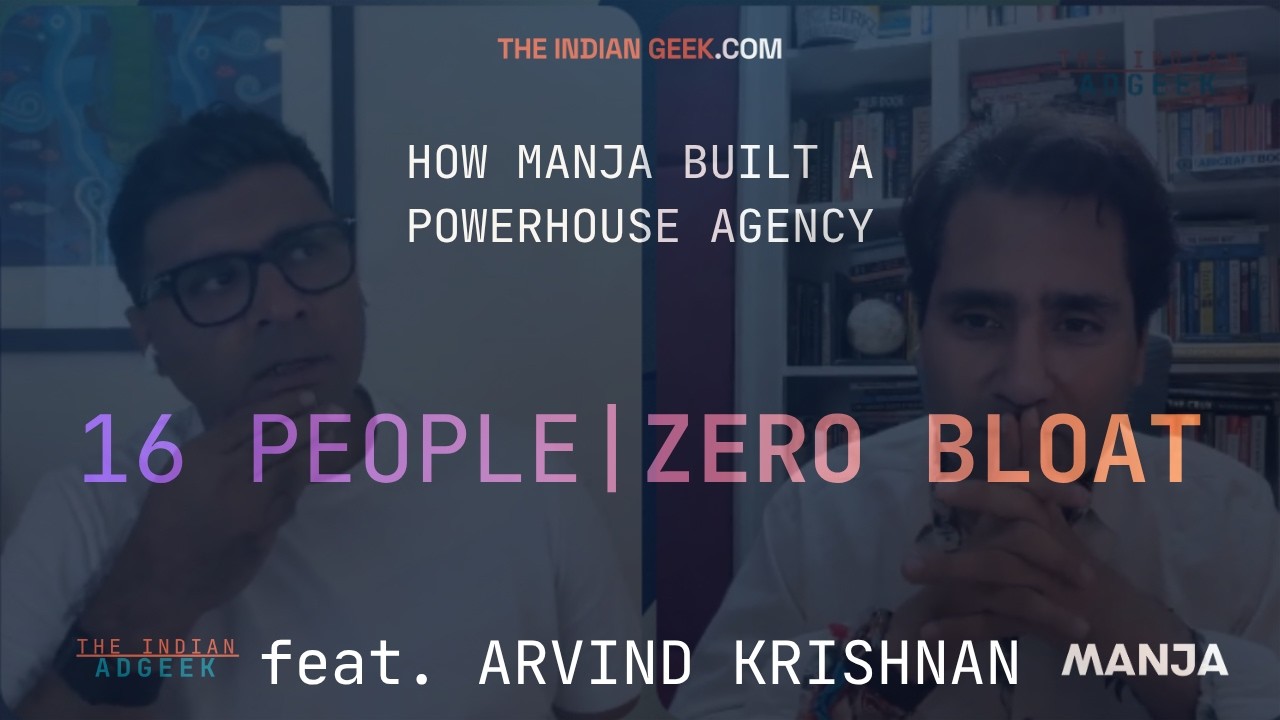
01 / THE DEEP READ
Editorial analysis
An editorial interpretation of the conversation, distinguishing the guest’s arguments from verified business outcomes.
An agency built around finite senior time
The scarce resource in Arvind Krishnan’s account of MANJA is senior attention. A small agency can promise direct access to experienced practitioners, but every additional assignment draws on the same finite supply. He describes declining projects when the leadership team could not give them sufficient involvement. His possible route beyond that ceiling resembles a partnership: more leaders cultivating relationships, provided they can sustain a shared standard. Expansion should amplify the agency’s voice; simply adding people risks diluting what clients came to buy.
The two promises in projects and retainers
That makes the commercial model a practical expression of the creative promise. Krishnan distinguishes projects priced for the value of an answer from retained relationships that reserve people’s capacity. Experience accumulated over years cannot sensibly be valued only by the time spent producing a particular solution. Yet value-based pricing still involves negotiation, and rival agencies may price the same assignment very differently. Retainers carry their own discipline: selling a share of someone’s time means actually keeping that capacity available. His approximate revenue mix describes MANJA at the time, rather than a universal prescription.
Growing without a bureaucratic hierarchy
Growth follows the same logic. A temporary project win is an insecure basis for permanent hiring; longer commitments can support a team that subsequently takes on additional projects. Flatness, meanwhile, does not abolish operational responsibility. Krishnan describes experienced people remaining close to delivery and a relatively large creative contingent, while acknowledging the need for an operational layer. Nor does independence require rejecting tactical briefs. Sales campaigns can offer worthwhile creative problems; cultural incompatibility, inadequate capacity and a mismatch in capabilities are more useful reasons to decline work.
Find the problem before finding the idea
The interview’s creative argument is similarly grounded: spend time establishing the problem before rushing to answers. Krishnan recalls Amazon Music as a fulfilling collaborative process and credits receptive clients when discussing disruptive work. AI already helps his team gather and organise information and visualise possibilities, he says; people must still interpret the material and exercise judgment. His hope that technology could extend smaller teams’ global delivery remains a forecast. The longer-term ambition is harder to measure: culturally resonant work and people developed within the organisation might accumulate into agency equity. He recognises that MANJA is too young to claim that legacy.
Expertise accumulated over years cannot be valued by counting the hours required to produce an answer.
The economics of a senior-led small agency
An editorial visualisation of the relationships and choices discussed in this episode.
02 / EXPLORE THE ARGUMENT
Questions & answers
What constrains a small agency promising senior attention?
A promise of senior involvement creates a capacity ceiling. Krishnan sees selective acceptance and, eventually, partners held to a common standard as more credible responses than headcount growth alone.
How does a retainer differ economically from a project fee?
Project pricing and retainers sell different commitments. One values an answer and the expertise behind it; the other requires an honest reservation of people’s time, even while both remain subject to commercial negotiation.
When does an agency have enough certainty to hire?
Longer commitments can justify hiring that a short project cannot. Krishnan describes a reciprocal model in which stable relationships support a team and that team creates room for additional assignments.
What does flat structure still require?
Flatness needs capable operators. MANJA’s small team relies on experienced people doing the work and relatively few management layers, while Krishnan explicitly acknowledges the need for operational capacity.
Why should problem definition come before creative execution?
Problem definition is part of the creative work. The Amazon Music discussion emphasises finding a distinctive problem and voice through conversation before settling on an answer.
03 / TRANSPARENCY
Sources & attribution
Supporting references and reporting notes. Select a reference to visit its source.
Original publisher audio (archived enclosure): Original publisher audio (archived enclosure).
Podcast episode on Spotify: Podcast episode on Spotify.
Podcast video on YouTube: Podcast video on YouTube.
Original publication: The Indian AdGeek, Episode 36, featuring Arvind Krishnan; original publisher date: 2026-10-12.
Method and attribution: This analysis and the five Q&As are editorial syntheses, not verbatim statements or substitutes for listening to the original conversation. Guest judgments, examples, forecasts and reported business metrics should not be confused with independently audited findings. Research timestamps do not represent podcast chapter timings.