01 / THE DEEP READ
Editorial analysis
An editorial interpretation of the conversation, distinguishing the guest’s arguments from verified business outcomes.
What marketing must do, regardless of channel
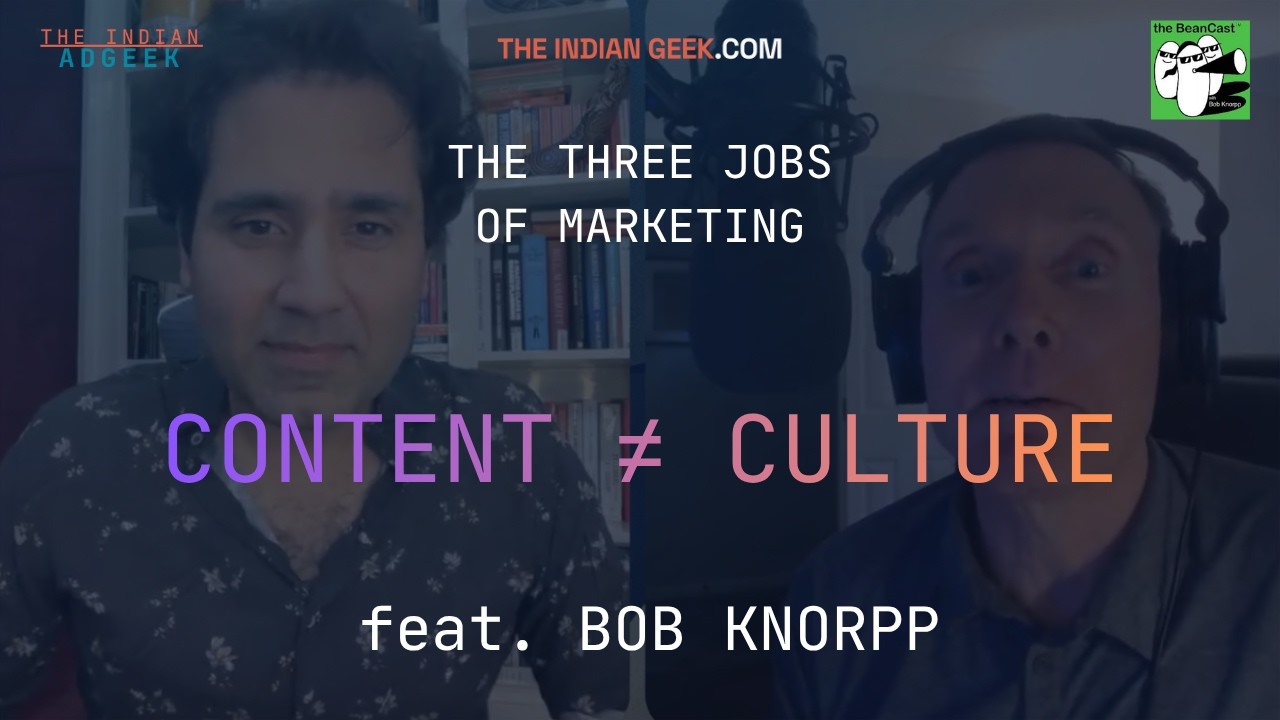
New channels do not necessarily create new marketing jobs. Bob Knorpp’s organising argument is that branding, direct marketing and public relations remain the core functions; social platforms, creators and other media offer ways to execute them. This is his framework rather than a settled taxonomy, and he softens an earlier objection to digital marketing as a separate discipline. The practical demand remains integration: campaigns need different balances of awareness, response and relationships, rather than allowing the easiest measurement or the strongest specialist to define the entire task.
Listening rather than simply borrowing culture
Culture raises a similar distinction between visible activity and underlying commitment. Knorpp contrasts producing topical content with listening to a community and allowing that knowledge to shape business decisions. His Harley-Davidson recollection illustrates the difference. When Vishal asks whether India’s long-standing fragmentation anticipates America’s experience, Knorpp resists a straightforward equivalence and acknowledges the limits of his familiarity with Indian advertising. His observation that Americans increasingly sample across brands is likewise presented as an interpretation of his own market. The proposed explanations remain tentative, rather than proof that brand loyalty has disappeared everywhere.
A bigger job for agency advisers
For agencies, these arguments challenge the response to cheaper creator-style production. Knorpp regards cost cutting as an inadequate answer to a question about value. He wants advisers able to orchestrate the wider marketing problem, while recognising that creators can contribute cultural fluency without automatically possessing every strategic capability. Reviewers and influencers serve different purposes according to a buyer’s proximity to purchase. The incentive problem also sits with clients: short-term reward structures, he argues, encourage narrow performance assignments and make a broader agency relationship harder to sustain.
AI and the judgement it cannot replace
His position on AI follows that commercial logic. Collaboration could strengthen human work, but replacing people chiefly to cut costs risks losing the judgment required to persuade customers. He rejects a separate creative brief addressed to shopping agents: the proposition should still serve people, while useful product information becomes easier for agents to retrieve. Gaming offers another test of context, with natural placements contrasted against interruptions. Even controversy needs a route into a meaningful relationship. The closing Fair, Fail, Foul round is not a blanket rejection of new tools; it asks whether a tactic supports the customer and the wider marketing job.
Marketing has three jobs; channels are not strategies.
Three enduring jobs of marketing
An editorial visualisation of the relationships and choices discussed in this episode.
02 / EXPLORE THE ARGUMENT
Questions & answers
Do new channels create fundamentally new marketing functions?
A channel label does not settle the strategy. Knorpp’s three-function framework asks campaigns to balance branding, response and public relations according to the audience and task, rather than treating every new medium as a replacement discipline.
When does cultural participation become more than content?
Cultural participation requires a feedback loop into the business. In Knorpp’s account, listening becomes consequential when it influences decisions; topical content alone is a thinner form of engagement.
Can brands combine broad reach with individual relevance?
Individual relevance and broad brand-building serve different needs. Knorpp values personal interests near the sale while retaining a role for demographics and wider brand reach; fandoms do not simply make other planning tools obsolete.
Why can’t agencies defend their value by becoming cheaper producers?
Cheap execution is a weak defence of agency value. Knorpp argues for a broader advisory relationship and gives leadership of the account to whoever can orchestrate the whole marketing mix.
How do creators and reviewers play different roles?
Creators and reviewers are not interchangeable. Knorpp distinguishes awareness from active purchase research, and cultural fluency from the full set of skills needed to act as a client’s agency.
03 / TRANSPARENCY
Sources & attribution
Supporting references and reporting notes. Select a reference to visit its source.
Original publisher audio (archived enclosure): Original publisher audio (archived enclosure).
Podcast episode on Spotify: Podcast episode on Spotify.
Podcast video on YouTube: Podcast video on YouTube.
Original publication: The Indian AdGeek, Episode 37, featuring Bob Knorpp; original publisher date: 2026-10-26.
Method and attribution: This analysis and the five Q&As are editorial syntheses, not verbatim statements or substitutes for listening to the original conversation. Guest judgments, examples, forecasts and reported business metrics should not be confused with independently audited findings. Research timestamps do not represent podcast chapter timings.