01 / THE DEEP READ
Editorial analysis
This edition is based on preserved guest-response material. The questions below are editorial guides to that material, not recovered questions asked by the host.
Start with the business problem
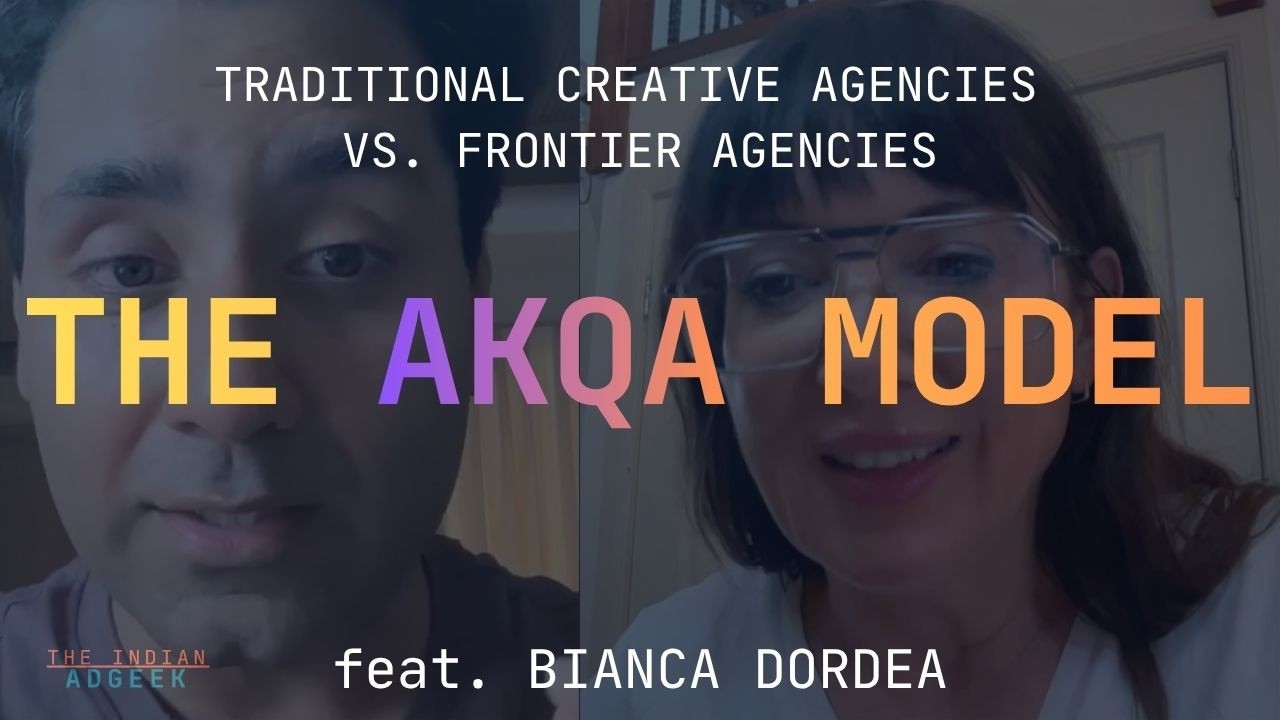
Bianca Dordea describes AKQA as a frontier agency whose role starts with a business problem rather than a fixed service category. Its work can combine design, creativity, brand strategy and growth modelling, depending on what a client needs. She connects that flexibility to people who think across disciplines: creative leaders interested in systems and product designers attentive to feelings and human insights. Reflecting on leading an office in Germany, she also describes the shift from managing client satisfaction to taking responsibility for an evolving system of people, work and culture.
Be present before the brief exists
For Dordea, partnership means joining clients early enough to identify signals and articulate the problem together. She cites WPP’s OpenX model for Coca-Cola as an example of teams assembled around capabilities rather than geography or agency boundaries. This is her account of an operating model that continues to evolve with the client, rather than a claim that integration is frictionless: internal tensions still need managing so clients do not experience them. She argues for building culture around the client and the work, while acknowledging that agencies must set aside some of their own identities and that this remains difficult.
The economics of integrated capability
The commercial conversation, she suggests, should move from the cost of a prescribed deliverable to the resources an intended outcome requires. Procurement is part of the team, and existing systems need time to accommodate unfamiliar services and forms of value. Pitching follows a similar logic: repeated questions can reveal a problem beneath the requested campaign, while demos and prototypes let clients experience an idea. She sees a gradual move beyond slides, even when making a demonstrable concept takes more investment. The clients best suited to this approach, in her view, tolerate ambiguity, have decision-making authority and understand that a broken product experience cannot be repaired by a campaign.
Prototypes, clients and unfinished organisational change
Dordea welcomes in-house teams for their business knowledge while arguing that an external agency can contribute a perspective less tied to internal politics. She recognises consultancies as serious competitors, including in areas they are winning, and presents creative culture and the ability to demonstrate transformation as agency advantages rather than guarantees. On AI, she describes embracing agentic workflows that may accelerate or replace parts of a process, while expecting human judgment and imagination to remain differentiators for a while. Her account of craft and good work emphasises moving people, creating habits and leaving a legacy.
Start with the business problem.
Inside the frontier-agency model
An editorial visualisation of the relationships and choices discussed in this episode.
02 / EXPLORE THE ARGUMENT
Questions & answers
What is a frontier agency supposed to do?
Dordea’s frontier-agency proposition starts with the business problem and combines disciplines rather than prescribing one category of service.
Why does Dordea want agencies involved before a brief is final?
Early partnership lets agency and client define the problem together; Dordea treats it as more useful than receiving a finished brief as a supplier.
Why does integration remain an unfinished organisational task?
Capability-based integration needs continuous adjustment and a culture around the work; Dordea acknowledges internal friction and calls it a work in progress.
Where does procurement fit in a value conversation?
Procurement belongs in the team: Dordea advocates discussing what an outcome requires rather than pricing from a prescribed menu of deliverables.
What can a prototype do that a deck cannot?
Prototypes and demos can make a pitch idea tangible, though Dordea says they can require more time and focus.
03 / TRANSPARENCY
Sources & attribution
Supporting references and reporting notes. Select a reference to visit its source.
Original publisher audio (archived enclosure): Original publisher audio (archived enclosure).
Podcast episode on Spotify: Podcast episode on Spotify.
Podcast video on YouTube: Podcast video on YouTube.
Original publication: The Indian AdGeek, Episode 31, featuring Bianca Dordea; original publisher date: 2026-08-03.
Method and attribution: This analysis and the five Q&As are editorial syntheses, not verbatim statements or substitutes for listening to the original conversation. Guest judgments, examples, forecasts and reported business metrics should not be confused with independently audited findings. Research timestamps do not represent podcast chapter timings.
Guest-response-only source: The preserved source lacks the host’s questions. The five questions in this edition are reader-facing editorial formulations derived from guest themes, not reconstructions or quotations from the original host dialogue.