Skip to content
THE INDIAN GEEKAVIATION CONNECTS THE WORLD / ADVERTISING SHAPES HOW WE SEE ITEXPLORE THE INDIAN AVGEEK ↗
THE INDIAN AVGEEK EPISODE 080EDITORIAL KNOWLEDGE EDITION
AVIATION / THE BUSINESS OF FLIGHT

How Rome Fiumicino is building its next growth wave

Aeroporti di Roma’s Federico Scriboni explains Fiumicino’s expansion, how airports build new-route business cases, why India matters, and what the A321XLR could unlock.

WITH FEDERICO SCRIBONI 05 OCT 2026 34 MIN

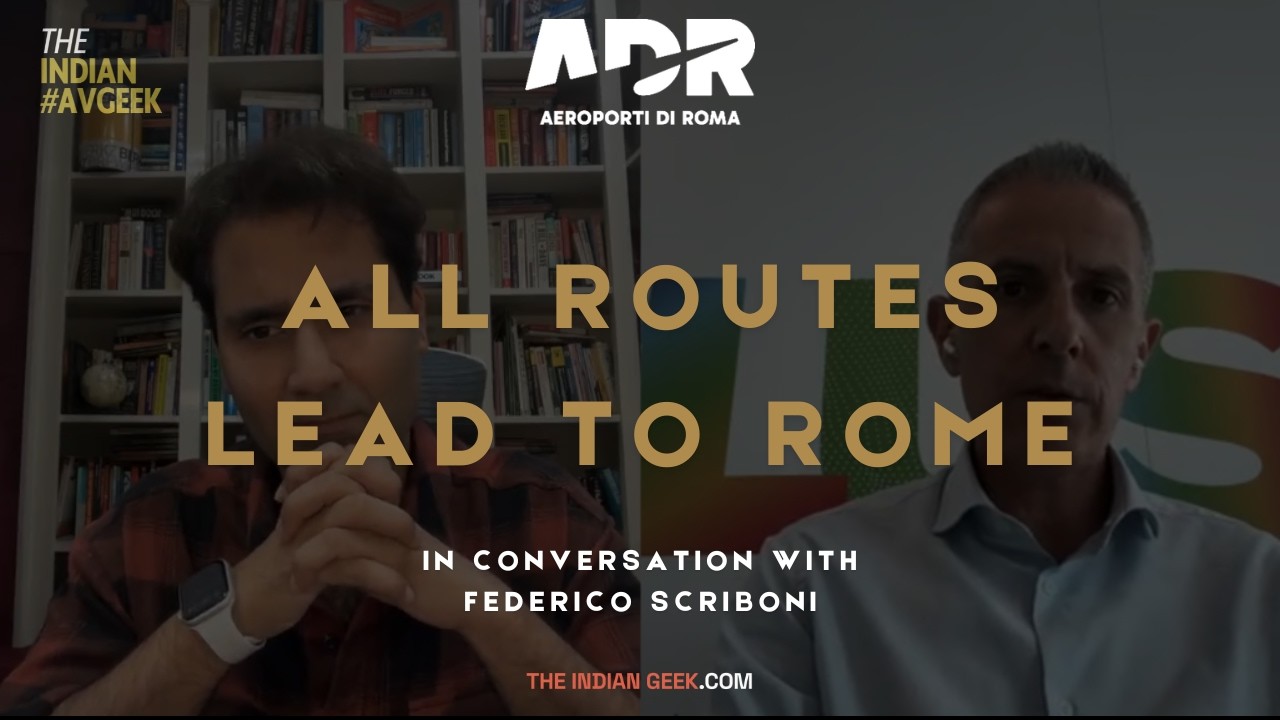
How Rome Fiumicino is building its next growth wave episode artwork
THE INDIAN AVGEEK080 / VIDEO PODCAST
PLAY THE AUDIO HEREEpisode 80 · Full conversationAudio plays directly on The Indian Geek.
THE CENTRAL QUESTION / WHAT YOU NEED TO KNOW
01 / THE QUESTION

What is ADR’s route-development formula?

02 / THE CONVERSATION IN BRIEF

Aeroporti di Roma’s Federico Scriboni explains Fiumicino’s expansion, how airports build new-route business cases, why India matters, and what the A321XLR could unlock.

03 / THE EDITORIAL LENS

Beyond a route map

01 / THE DEEP READ

Editorial analysis

Editorial context


Rome Fiumicino is pitching India, North America and thinner long-haul markets from a stronger base. Federico Scriboni explains why the most persuasive airport proposition starts—and ends—with airline economics.


Recovery has become a capacity-planning problem


Rome Fiumicino’s recovery is not simply a return to pre-pandemic traffic. Federico Scriboni says the airport handled approximately 51.3 million passengers in 2025 versus 43.5 million in 2019. Those figures are presented as contemporary ADR statements rather than independently audited totals in this edition. Their consequence is more important than the headline: growth creates a new infrastructure sequencing problem. Airports that add traffic faster than stands, runways, terminal processing and airline operating windows can accommodate it risk converting success into worsening reliability. Scriboni argues that quality remained an institutional priority through the pandemic and recovery. The test is whether ADR can retain passenger experience and airline confidence while pushing towards the next phase of expansion.


The magic triangle of a route


Scriboni offers a clear description of successful route development: evidence of market opportunity, commercial and marketing support, and operational execution. Airports sometimes emphasise the second part because promotional commitments are visible and negotiable. In practice, the first and third are harder to replace. Airlines need proof that enough passengers will pay the right fare, including the appropriate connecting markets; they also need slots, stands and a schedule that makes the route work. ADR can use data familiar to airline planners to make the case, but both sides must agree on underlying definitions. Demonstrating a large Indian market to Italy is not the same as demonstrating a profitable Delhi–Rome flight with acceptable aircraft utilisation.


India is a portfolio of route opportunities


The airport already has links involving Air India and ITA Airways between Rome and Delhi, while seeing scope for stronger India services and additional city pairs. India’s domestic scale, outbound tourism and diaspora links strengthen the case, but long-haul route forecasts must distinguish point-to-point demand from onward travel. ITA’s integration into Lufthansa Group and Star Alliance changes the connecting proposition, potentially giving India–Rome services additional value through coordinated networks. Yet alliance membership does not guarantee a seamless connection or an attractive through fare. The opportunity must be tested against competing one-stop itineraries and the different seasonality of tourism, student and business travel. In that sense, India is not one large statistic but a collection of route-level investment cases.


A technical stop is not the same as a hub


Scriboni discusses the use of Rome by aircraft affected by longer routings when airspace closures increase flight distances. A technical stop can be valuable, and an airport that supplies one efficiently may earn commercial relationships. But a refuelling stop is analytically different from a scheduled connecting hub: passengers may stay on board, there may be no viable onward bank, and the economics may be temporary. If Indian carriers use Rome to mitigate airspace constraints on North American flights, that is evidence of operational flexibility rather than proof that a permanent India–Rome–US transfer market exists. Route-development teams should distinguish temporary operational demand from traffic capable of sustaining a published schedule.


North America reveals the price of peak hours


North American demand to Rome is substantial, but arriving flights cluster in useful morning and early-afternoon windows. Scriboni explains why simply adding another flight at an off-peak time may be commercially unattractive: the arriving passenger loses desirable connections and travel-time convenience. That concentrates pressure on runway and stand capacity during the hours already in demand. ADR’s proposed fourth-runway expansion is therefore more than a physical-growth scheme; it is an attempt to make future flight banks operationally possible. The correct business case needs peak-hour movements, passenger processing and reliability, not an annual passenger target alone. A runway can create flexibility but does not guarantee attractive slot timings or profitable new transatlantic demand.


The A321XLR changes the threshold—not every answer


For India–Europe connectivity, the Airbus A321XLR offers the possibility of serving markets below the demand needed for a larger widebody aircraft. Scriboni sees an opportunity for IndiGo and for airports willing to support new services, while conceding that real-world range and operational performance remain important uncertainties. That caution should be preserved. A published range figure is not a guaranteed commercial payload under every wind, reserve, diversion and airspace scenario. Thin long-haul flying also imposes product and schedule expectations that cannot be read off the aircraft manufacturer’s brochure. The strategic change is a lower potential entry threshold for certain destinations, not proof that every city pair within nominal range will work. Route profitability remains a function of fares, frequency, load factor and cost.


Two airports, two different jobs


ADR manages both Fiumicino and Ciampino, whose network roles and operating conditions differ. Fiumicino is the long-haul and full-service centre; Ciampino offers another proposition with its own constraints and airline mix. The challenge is not merely allocating airlines by brand. A carrier may operate from both airports, and travellers weigh ground access and schedules as well as fares. The group must avoid presenting the existence of two airports as automatically doubling usable capacity. Runway use, terminal arrangements, noise rules and transport links determine how substitutable the facilities actually are. Scriboni’s treatment of the two-airport system offers a reminder that an airport group should optimise the metropolitan market without eroding the distinct economics of each site.


Beyond a route map


The most revealing aspect of the interview is Scriboni’s approach to airport growth as a repeated commercial negotiation. Aircraft orders and GDP forecasts can identify a promising direction, but they cannot settle a route. Airline partners will ask whether Rome fills a genuine network gap, whether passengers will choose the itinerary at a sustainable yield, whether the ground operation protects a tight connection and whether traffic can be absorbed at the required hour. The airport’s investment in infrastructure, marketing and airline service has to reinforce that basic business case. Rome may be an increasingly important India-facing gateway. It will earn that position one viable route and operating bank at a time.

EDITORIAL THESIS

A route is a negotiation between market demand and operating reality.

EXPLAINING THE ARGUMENTEDITORIAL / 01

What makes an airline route viable?

An editorial visualisation of the relationships and choices discussed in this episode.

01Market demandA route needs sustainable passenger demand
02Aircraft economicsRange and aircraft size change the threshold
03Airport capacitySlots, peaks and connectivity constrain choices
Editorial schematic drawn from this episode's conversation and analysis. Illustrative, not a quantitative model.

02 / EXPLORE THE ARGUMENT

Questions & answers

What is ADR’s route-development formula?


Prove the market opportunity, create suitable commercial support and execute operationally at the slots and quality airlines need.


Why is India a priority?


Growing traffic, airline capacity plans and existing Delhi connectivity provide an opportunity, subject to route-level demand.


Does a Rome technical stop make an India–US hub?


No. Operational refuelling and scheduled transfer connectivity have different commercial economics.


How might the A321XLR change the market?


It may permit smaller long-haul markets with lower aircraft capacity, but payload, reserves and real operating costs must be modelled.


Why consider a fourth runway?


Additional peak-hour availability may support future North American and other long-haul capacity while protecting schedule quality.

03 / TRANSPARENCY

Sources & attribution

Supporting references and reporting notes. Select a reference to visit its source.

Original recording and provenance: Listen to the original AvGeek episode. First released 05 October 2026.


Editorial basis: Interpretive analysis of the published discussion and available archive evidence. Questions and answers are editorial paraphrases, not verbatim interview quotations. Historical statements are attributed to the recording context, not certified as current October 2026 facts.


Commercial context: The Rome Fiumicino route plans, incentives, A321XLR and North America analysis reflect the October 2026 discussion; proposed flights are not confirmed operating services.

THE INDIAN AVGEEK / EDITORIAL EDITION 080EXPLORE MORE BRIEFINGS ↗
THE INDIAN GEEKAVIATION CONNECTS THE WORLD. ADVERTISING SHAPES HOW WE SEE IT.

AVGEEK

How Rome Fiumicino is building its next growth wave

Aeroporti di Roma’s Federico Scriboni explains Fiumicino’s expansion, how airports build new-route business cases, why India matters, and what the A321XLR could unlock.

The conversation

Rome Fiumicino has moved from recovery to another major growth cycle.

In Episode 80 of The Indian AvGeek, Vishal Mehra speaks with Federico Scriboni, Director Aviation Business Development at Aeroporti di Roma, about the commercial and infrastructure decisions behind one of Europe’s fastest-growing hubs.

They discuss Fiumicino’s investment programme and future capacity, how airports build the business case for new airline routes, Rome’s ambitions for India, conversations with IndiGo, the role of Air India and ITA Airways, and how the Airbus A321XLR could change the economics of thinner long-haul markets.

The conversation also looks at Rome’s growing North American connectivity, the next phase of airport infrastructure and how Fiumicino and Ciampino play very different roles within the same airport system.

Key Takeaways

  1. Federico Scriboni described roughly €3 billion of investment by Aeroporti di Roma over the preceding 15 years, refurbishing facilities and nearly doubling Fiumicino’s capacity while pursuing better service. Those are his episode-era figures and objectives, not a newly audited account of investment or current capacity.
  2. His route-development framework has three connected parts: market opportunity, commercial and marketing support, and the operational ability to make the flight work. Evidence of demand or an incentive on its own does not complete that commercial case.
  3. In the interview, Scriboni described Air India and ITA Airways serving Delhi, while Mumbai, Bengaluru and Chennai remained unserved opportunities in Rome’s India proposition. Discussions with IndiGo were exploratory: neither a proposed city nor a conversation confirmed a service, aircraft type or start date.
  4. The stated plan was to move toward roughly 66 million passengers a year of capacity, with a fourth runway forming part of the next investment phase. North American arrivals concentrated demand in valuable peak banks, so spare annual capacity did not mean equivalent headroom at every hour; these were plans and constraints, not completed infrastructure.
  5. In Scriboni’s view, the A321XLR could support thinner markets and weaker seasonal periods with less exposure than larger aircraft, with IndiGo a prominent potential case. Actual range, payload, routing and yields still had to support the mission; the aircraft did not guarantee a viable Rome route.
  6. The episode describes temporary technical stops by India–North America services and an expectation that more direct flying could return. Such stops do not establish a permanent passenger hub or demonstrate sustainable connecting-network economics.
  7. Fiumicino and Ciampino have different roles despite a common operator. Scriboni described Fiumicino as the main intercontinental hub and investment focus, while Ciampino combined low-cost operations with general aviation; the airports should not be treated as interchangeable markets.

Additional subjects

Editorial analysis

Editorial context


Rome Fiumicino is pitching India, North America and thinner long-haul markets from a stronger base. Federico Scriboni explains why the most persuasive airport proposition starts—and ends—with airline economics.


Recovery has become a capacity-planning problem


Rome Fiumicino’s recovery is not simply a return to pre-pandemic traffic. Federico Scriboni says the airport handled approximately 51.3 million passengers in 2025 versus 43.5 million in 2019. Those figures are presented as contemporary ADR statements rather than independently audited totals in this edition. Their consequence is more important than the headline: growth creates a new infrastructure sequencing problem. Airports that add traffic faster than stands, runways, terminal processing and airline operating windows can accommodate it risk converting success into worsening reliability. Scriboni argues that quality remained an institutional priority through the pandemic and recovery. The test is whether ADR can retain passenger experience and airline confidence while pushing towards the next phase of expansion.


The magic triangle of a route


Scriboni offers a clear description of successful route development: evidence of market opportunity, commercial and marketing support, and operational execution. Airports sometimes emphasise the second part because promotional commitments are visible and negotiable. In practice, the first and third are harder to replace. Airlines need proof that enough passengers will pay the right fare, including the appropriate connecting markets; they also need slots, stands and a schedule that makes the route work. ADR can use data familiar to airline planners to make the case, but both sides must agree on underlying definitions. Demonstrating a large Indian market to Italy is not the same as demonstrating a profitable Delhi–Rome flight with acceptable aircraft utilisation.


India is a portfolio of route opportunities


The airport already has links involving Air India and ITA Airways between Rome and Delhi, while seeing scope for stronger India services and additional city pairs. India’s domestic scale, outbound tourism and diaspora links strengthen the case, but long-haul route forecasts must distinguish point-to-point demand from onward travel. ITA’s integration into Lufthansa Group and Star Alliance changes the connecting proposition, potentially giving India–Rome services additional value through coordinated networks. Yet alliance membership does not guarantee a seamless connection or an attractive through fare. The opportunity must be tested against competing one-stop itineraries and the different seasonality of tourism, student and business travel. In that sense, India is not one large statistic but a collection of route-level investment cases.


A technical stop is not the same as a hub


Scriboni discusses the use of Rome by aircraft affected by longer routings when airspace closures increase flight distances. A technical stop can be valuable, and an airport that supplies one efficiently may earn commercial relationships. But a refuelling stop is analytically different from a scheduled connecting hub: passengers may stay on board, there may be no viable onward bank, and the economics may be temporary. If Indian carriers use Rome to mitigate airspace constraints on North American flights, that is evidence of operational flexibility rather than proof that a permanent India–Rome–US transfer market exists. Route-development teams should distinguish temporary operational demand from traffic capable of sustaining a published schedule.


North America reveals the price of peak hours


North American demand to Rome is substantial, but arriving flights cluster in useful morning and early-afternoon windows. Scriboni explains why simply adding another flight at an off-peak time may be commercially unattractive: the arriving passenger loses desirable connections and travel-time convenience. That concentrates pressure on runway and stand capacity during the hours already in demand. ADR’s proposed fourth-runway expansion is therefore more than a physical-growth scheme; it is an attempt to make future flight banks operationally possible. The correct business case needs peak-hour movements, passenger processing and reliability, not an annual passenger target alone. A runway can create flexibility but does not guarantee attractive slot timings or profitable new transatlantic demand.


The A321XLR changes the threshold—not every answer


For India–Europe connectivity, the Airbus A321XLR offers the possibility of serving markets below the demand needed for a larger widebody aircraft. Scriboni sees an opportunity for IndiGo and for airports willing to support new services, while conceding that real-world range and operational performance remain important uncertainties. That caution should be preserved. A published range figure is not a guaranteed commercial payload under every wind, reserve, diversion and airspace scenario. Thin long-haul flying also imposes product and schedule expectations that cannot be read off the aircraft manufacturer’s brochure. The strategic change is a lower potential entry threshold for certain destinations, not proof that every city pair within nominal range will work. Route profitability remains a function of fares, frequency, load factor and cost.


Two airports, two different jobs


ADR manages both Fiumicino and Ciampino, whose network roles and operating conditions differ. Fiumicino is the long-haul and full-service centre; Ciampino offers another proposition with its own constraints and airline mix. The challenge is not merely allocating airlines by brand. A carrier may operate from both airports, and travellers weigh ground access and schedules as well as fares. The group must avoid presenting the existence of two airports as automatically doubling usable capacity. Runway use, terminal arrangements, noise rules and transport links determine how substitutable the facilities actually are. Scriboni’s treatment of the two-airport system offers a reminder that an airport group should optimise the metropolitan market without eroding the distinct economics of each site.


Beyond a route map


The most revealing aspect of the interview is Scriboni’s approach to airport growth as a repeated commercial negotiation. Aircraft orders and GDP forecasts can identify a promising direction, but they cannot settle a route. Airline partners will ask whether Rome fills a genuine network gap, whether passengers will choose the itinerary at a sustainable yield, whether the ground operation protects a tight connection and whether traffic can be absorbed at the required hour. The airport’s investment in infrastructure, marketing and airline service has to reinforce that basic business case. Rome may be an increasingly important India-facing gateway. It will earn that position one viable route and operating bank at a time.

Questions & answers

What is ADR’s route-development formula?


Prove the market opportunity, create suitable commercial support and execute operationally at the slots and quality airlines need.


Why is India a priority?


Growing traffic, airline capacity plans and existing Delhi connectivity provide an opportunity, subject to route-level demand.


Does a Rome technical stop make an India–US hub?


No. Operational refuelling and scheduled transfer connectivity have different commercial economics.


How might the A321XLR change the market?


It may permit smaller long-haul markets with lower aircraft capacity, but payload, reserves and real operating costs must be modelled.


Why consider a fourth runway?


Additional peak-hour availability may support future North American and other long-haul capacity while protecting schedule quality.

Sources & attribution

Original recording and provenance: Listen to the original AvGeek episode. First released 05 October 2026.


Editorial basis: Interpretive analysis of the published discussion and available archive evidence. Questions and answers are editorial paraphrases, not verbatim interview quotations. Historical statements are attributed to the recording context, not certified as current October 2026 facts.


Commercial context: The Rome Fiumicino route plans, incentives, A321XLR and North America analysis reflect the October 2026 discussion; proposed flights are not confirmed operating services.

THE INDIAN GEEK

Aviation connects the world.
Advertising shapes how we see it.