01 / THE DEEP READ
Editorial analysis
A market rich in demand but constrained by distance
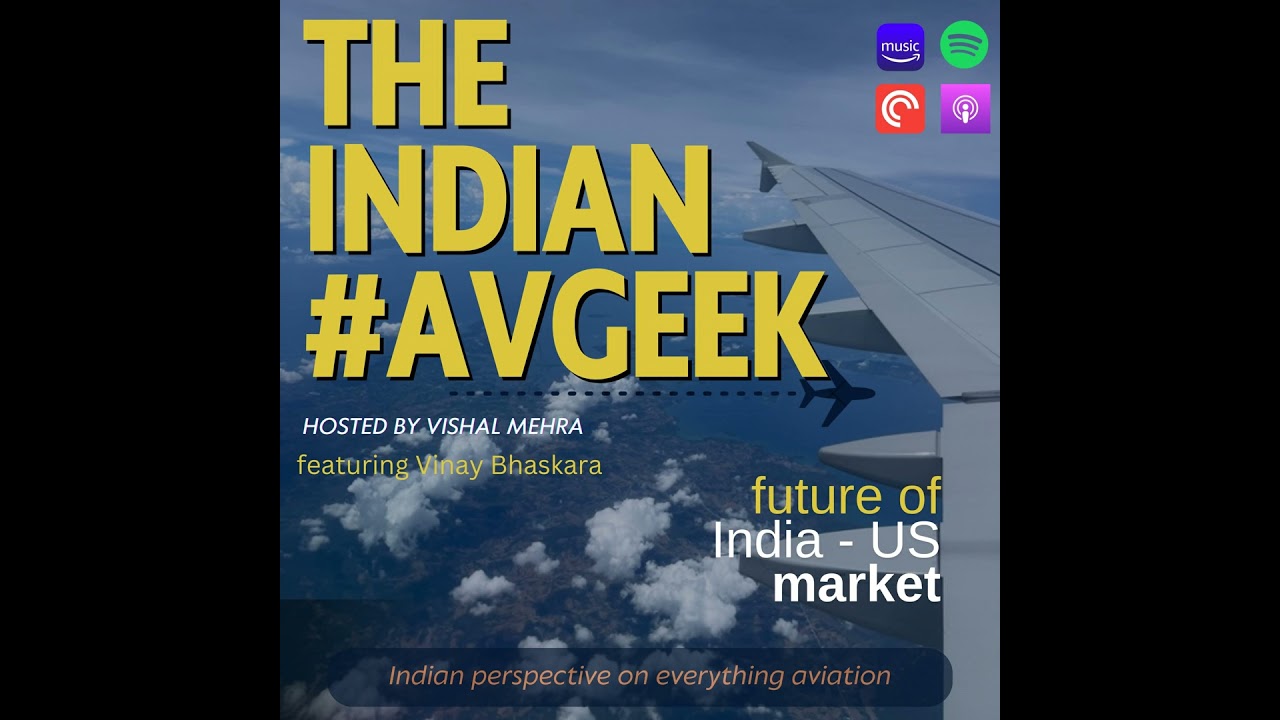
The India–US market is often described as the obvious next frontier for nonstop aviation, but Vinay Bhaskara describes a structurally more complicated proposition. The Indian-American diaspora is expanding in purchasing power, India’s economy is generating higher-value connections with US businesses, and several long-haul city pairs show substantial connecting demand. Yet an economically strong origin-and-destination market can fail to support a nonstop flight because of great-circle distance, political airspace restrictions, the scarcity of suitable widebodies and an unfavourable balance between visiting-friends-and-relatives traffic and premium yields.
Machine learning is not the same as autonomous operations
The conversation starts in technology. Bhaskara distinguishes mature airline machine learning used in pricing and analytics from newer generative and agentic AI that could take over customer-service and reservations workflows. He sees a near-term opportunity in digital administrative tasks but a much longer path to replacing people in the physical airport or cockpit. That difference is not semantic: a system processing a voluntary itinerary change can be tested and supervised differently from security screening or aircraft operation.
Why NDC migrations can fail
He also uses American Airlines’ difficult New Distribution Capability transition to illustrate the difference between a superior technological architecture and a successful migration. The host raises the resignation of a senior commercial executive after controversy over American’s distribution changes. Bhaskara argues that middlemen and corporate travel buyers are stakeholders in the system; even a technically sensible shift can fail if implemented too abruptly or accompanied by an aggressive change in distribution economics. The host contrasts United’s more gradual approach.
The Dallas–Hyderabad route test
The central route case is Dallas–Hyderabad. Bhaskara cites substantial measured connecting demand and compares its volume with Dallas–Amsterdam, but the episode does not supply the data source, the measurement period or the precise definition of passenger demand. Those figures must be attributed to him and not adopted as independently audited route statistics. Even with a sizeable diaspora, a very long stage length and lower yield relative to premium-heavy corporate markets make a nonstop difficult; blocked Russian airspace further complicates US-airline performance.
Different carriers face different network economics
The competitive section does not treat “US carriers” as one entity. Delta’s Atlantic links, United’s global widebody operations, American’s more constrained long-haul posture and Alaska/Hawaiian’s emerging 787 capacity create different options. Gulf carriers can combine extensive Indian feeder networks with attractive one-stop itineraries. Air India’s opportunity is to offer nonstops and a strong Indian hub, but Bhaskara argues that onward domestic connections, transfer experience and consistent onboard quality must improve to convert that network into a premium proposition.
A large India–US travel market does not guarantee a profitable nonstop on every city pair.
The India–US nonstop route test
An editorial visualisation of the relationships and choices discussed in this episode.
02 / EXPLORE THE ARGUMENT
Questions & answers
Where do AI and aviation meet?
Existing pricing analytics differ from emerging agentic systems, which are more likely to enter customer service and reservations before physical airport work.
Can AI improve GDS/NDC and reservations?
Yes, though American’s distribution conflict shows adoption must account for agents and corporate partners.
Why no Dallas–Hyderabad nonstop?
Distance, overflight restrictions, aircraft and fare mix, despite cited connecting demand.
What challenges do they face against Gulf carriers?
Extensive Indian connectivity and superior journey/connection characteristics can sustain one-stop competition.
What could Air India leverage?
Its home network and direct access, provided its connecting product and premium travel proposition improve.
03 / TRANSPARENCY
Sources & attribution
Supporting references and reporting notes. Select a reference to visit its source.
Original recording: The Indian AvGeek — Episode 26. Original episode published 09 February 2025.
Editorial context: This analysis examines the conversation in its original 2025 setting. Forecasts, strategy proposals, statistics and other assessments are attributed to that historical discussion, not presented as independently verified facts about October 2026.
Q&A note: These are edited, source-grounded explanations rather than verbatim quotations. Publication requires editorial review of sensitive claims and any uncertain transcript names or figures.
Data caveat: Route-demand comparisons discussed in this edition were not independently audited against the underlying dataset.