01 / THE DEEP READ
Editorial analysis
The industry problem behind the numbers
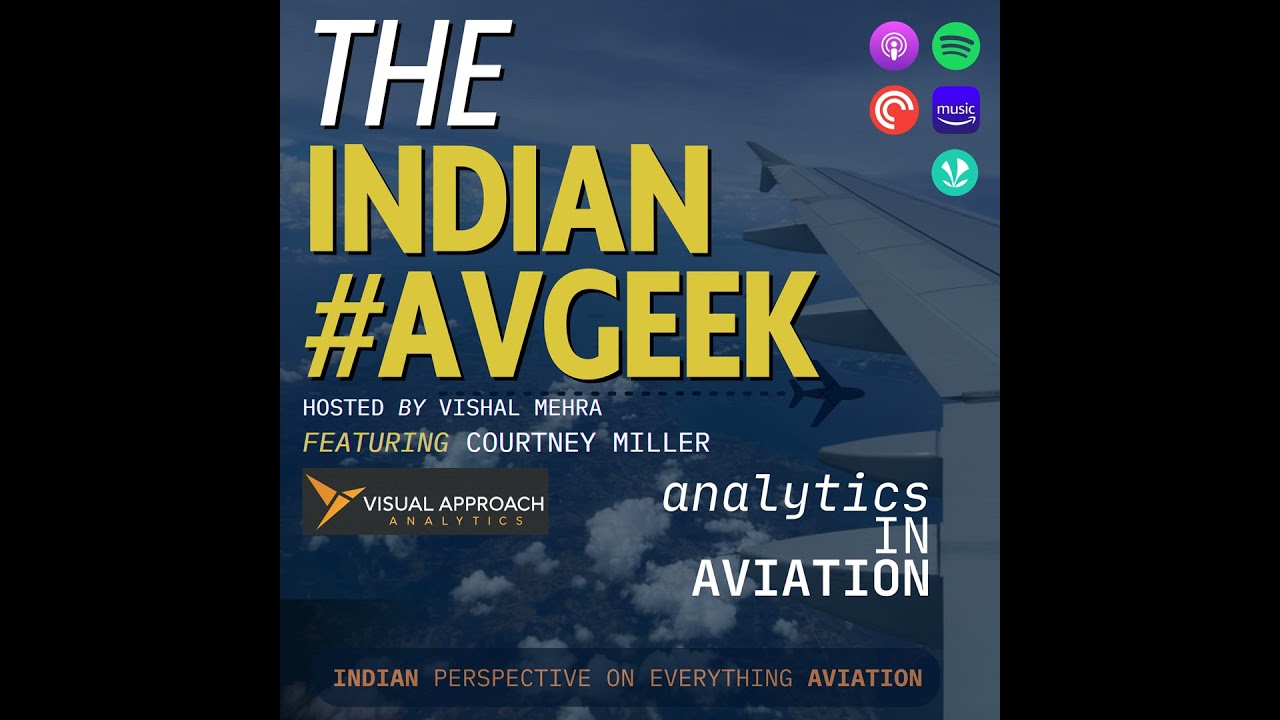
Courtney Miller began as a pilot and moved into aviation analysis. He brings a practitioner’s scepticism to stories about demand and capacity: the existence of a numerical trend does not mean an airline should extrapolate it into another aircraft order. A particularly instructive contrast is passenger versus cargo networks. Passengers can enter and leave the aircraft under their own power; cargo must be physically moved, sorted and often trucked, changing both cost and network design. The lesson is methodological: the right unit of analysis depends on the operation.
Forecasting cause and consequence
The discussion takes off when Miller recalls forecasting a shortage of airline pilots and a later tightening of aircraft availability during the industry’s post-pandemic adjustment. He describes working through causal chains rather than treating the initial shock as an isolated data point. The value is not that one analyst foresaw every development; this is his account and the interview supplies no formal forecast scorecard. The value is to ask where a change in aircraft production, training pipeline, labour costs or maintenance downtime will surface next in the industry system.
India’s capacity discipline test
On India, Miller is wary of the assumption that rapid growth automatically rewards every competitor. He argues that persistent additions of capacity can undermine returns and that disciplined execution matters more than a perpetual race for market share. He contrasts different airline business models globally and invites India’s carriers to be strategically distinctive rather than reproduce a foreign model mechanically. The revealing problem is behavioural: when an industry grows quickly, managers can continue to pursue scale beyond the point where it creates value.
Where aviation AI might actually pay
His perspective on AI is similarly precise. He traces the move from collecting very large datasets to actually asking answerable operational questions. He is sceptical that generic language models will deliver the biggest gains. Rather, he highlights specific machine-learning approaches to aircraft and engine maintenance, including predicting life-limited-part requirements and organising shop visits. That is a plausible high-value application because a useful forecast can change an actual schedule or maintenance procurement choice. It is not a proven quantified benefit in the transcript.
A forecast becomes useful when it explains how one constraint changes the next.
How an aviation shock propagates through a network
An editorial visualisation of the relationships and choices discussed in this episode.
02 / EXPLORE THE ARGUMENT
Questions & answers
What distinguishes cargo route planning?
Its loading, handling and inland distribution requirements make the network economics different from passenger services.
How does Miller describe a valuable forecast?
A causal chain exposing what happens next to aircraft, capacity or labour—not a single headline number.
Why does India’s growth not guarantee airline profits?
Repeated capacity additions can depress yields before operational discipline has matured.
Does the low-cost airline model still work?
He points to operators such as Ryanair and distinguishes the model from carriers whose execution and costs have deteriorated.
Where might AI improve outcomes?
Specific machine-learning forecasts for maintenance planning and engine-part lifecycle management.
03 / TRANSPARENCY
Sources & attribution
Supporting references and reporting notes. Select a reference to visit its source.
Original interview: The Indian AvGeek — Episode 54. Published 16 November 2025.
Editorial context: This is a researched interpretation of the original conversation, not a verbatim transcript. Guests’ statements, forecasts and business or policy assessments are presented in their original 2025 context; they should not be treated as independently verified current conditions.
Editorial Q&A: Questions and answers are explanatory paraphrases, not quotations from the speakers.