01 / THE DEEP READ
Editorial analysis
Editorial context
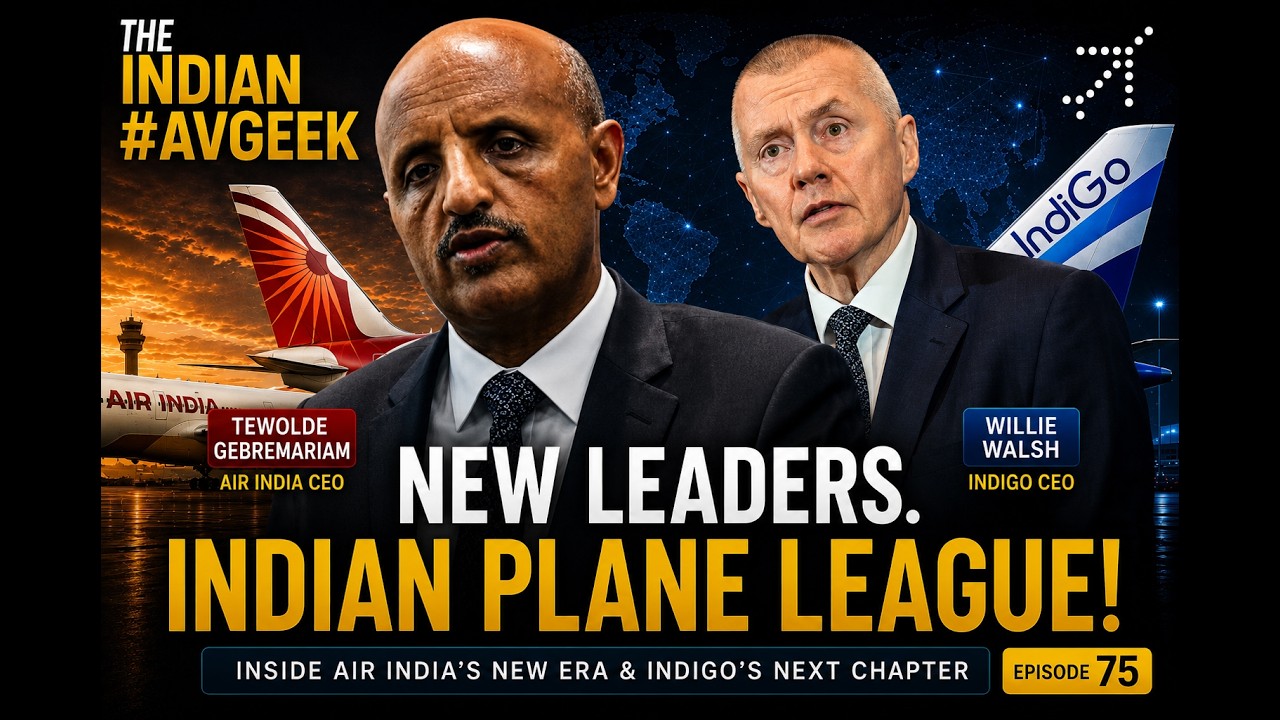
Air India announced the incoming architect of Ethiopian Airlines’ expansion while IndiGo welcomed Willie Walsh as its new chief executive. The real question was not celebrity leadership but which operating model could survive India’s next phase of international competition.
The week that changed the conversation
This emergency episode was recorded against a striking news cluster. Air India announced Tewolde Gebremariam as its incoming chief executive on 5 August 2026, without a confirmed joining date in that announcement; Willie Walsh had assumed charge at IndiGo on 3 August 2026; and the carriers were taking notably different approaches to long-haul capacity. The conversations around new leaders can easily become personality analysis. Ameya Joshi and Sean Mendis instead ask what, precisely, each leader is being hired to execute. Air India needs an integrated full-service long-haul operation; IndiGo needs to preserve cost discipline while acquiring the capabilities for more complex international flying. The two problems are related but far from identical.
The Ethiopian analogy has limits
Mendis, who knew Tewolde through his Ethiopian Airlines career, describes a manager capable of developing fleet, operations, training and hub connectivity in a difficult environment. That is relevant to Air India, but the analogy must be handled carefully. Ethiopian built transfer traffic because its home market alone could not support its international ambitions. India possesses a vast domestic origin-and-destination base, multiple competing gateways and much more dispersed aviation demand. Reproducing Ethiopian’s architecture without adapting it to Delhi, Mumbai and regional Indian markets would confuse a successful precedent with a transferable formula.
The hub is a timetable, not a flag
The discussion challenges the fashionable assumption that announcing a hub is enough to create one. A competitive connecting hub needs arrival and departure banks that work, resilient turnarounds, operational recovery, profitable domestic feed and products that make transfers tolerable. Many domestic Indian routes sustain frequency through local demand; long-haul thin routes require the airline to aggregate traffic from different origins into viable waves. That integration carries cost: schedule padding, missed-connection risk and occasional sacrifices to aircraft utilisation. A network that looks global on a route map can still fail to function as an efficient hub when measured by passenger itineraries.
Why IndiGo’s announced 787 wind-down mattered
The host probes IndiGo’s 31 July 2026 announcement of a planned end to its damp-leased Boeing 787 operations and asks whether the experiment was ever at efficient scale. IndiGo stated widebody flying would stop on 25 October and the Norse damp lease conclude on 31 October; Norse dated the end of their ACMI cooperation effective 1 November. Joshi and Mendis identify the exposure to lease economics, operating complexity, currency movement and changed airspace conditions. A temporary aircraft is not simply a smaller commitment than ownership: if the capacity cannot connect smoothly to the existing network and service model, it can be an expensive way to discover a market. The episode’s discussion is a contemporaneous diagnosis, not a verified calculation of lease profitability. Its central lesson is that fleet availability, network geography and commercial ambition have to mature together.
IndiGo’s leadership problem is disciplined evolution
Walsh’s background with British Airways, IAG and IATA creates an obvious image of global ambition. The harder job, as the guests suggest, is to broaden product and network reach without damaging the low-cost foundations that gave IndiGo scale. Premium cabins, loyalty, international transfers and long-haul operations each add complexity. Some complexity is profitable; some merely enlarges overhead. The executive task is to make the differentiation selective. A cost advantage can disappear incrementally, through dozens of rational-looking decisions that together produce a much more expensive airline.
Air India’s advantage carries an obligation
Air India has the brand history, domestic feed potential, large aircraft orders and a stronger starting claim to intercontinental service. Yet the guests stress the consequences of unreliable delivery against promises. A flagship carrier can spend heavily on cabins and marketing while disappointing customers through inconsistent aircraft, schedules or service. North American diaspora markets are important but seasonal, and a nonstop’s attractiveness depends on fares, connection alternatives and operating reliability. A new CEO may change incentives and execution culture; he cannot make a weak route profitable merely by importing experience from a different network.
Leadership announcements are not strategy outcomes
The merit of the episode lies in its refusal to pick a five-year winner on the basis of a single week. Air India and IndiGo each control different assets, operate different commercial propositions and face different execution risks. The test is how they deploy aircraft over seasons; whether they sustain on-time performance under stress; and whether premium demand, domestic connections and long-haul yields translate into durable cash generation. India could support both strong network airlines and fiercely competitive point-to-point operators, but not necessarily every route and business model that has been announced.
The hub is a timetable, not a flag.
A hub works only when the timetable works
An editorial visualisation of the relationships and choices discussed in this episode.
02 / EXPLORE THE ARGUMENT
Questions & answers
Why was this a special episode?
The combination of the new Air India CEO announcement, Walsh’s arrival and significant long-haul strategy changes warranted an out-of-cycle discussion.
Can Air India copy Ethiopian?
It can learn from Ethiopian’s execution and hub discipline, but India’s much larger origin-and-destination market changes the planning problem.
What does the announced 787 wind-down suggest?
The announced withdrawal illustrates operational and economic exposure when leased long-haul capacity is not yet integrated at scale. It is not proof of a particular audited loss or single cause.
Will Walsh make IndiGo full-service?
The transcript supports no such certainty; the strategic tension is expansion while preserving the unit-cost base.
Which airline will win?
The guests offer contrasting scenarios, not a determinative forecast. Sustained operations, cash flow and network economics will decide.
03 / TRANSPARENCY
Sources & attribution
Supporting references and reporting notes. Select a reference to visit its source.
Original recording and provenance: Original Spotify-hosted publisher episode. First released 07 August 2026.
Editorial basis: Interpretive analysis of the published discussion and available archive evidence. Questions and answers are editorial paraphrases, not verbatim interview quotations. Historical statements are attributed to the recording context, not certified as current October 2026 facts.
Editorial note: Executive appointments, India fleet changes and corporate strategy claims are discussed as historical August 2026 reporting and guest analysis; verify original announcements.
Primary-source chronology: Air India’s 5 August appointment announcement did not set an exact onboarding date. IndiGo’s 3 August CEO announcement confirms Walsh assumed charge. IndiGo’s 31 July press release announced the end of widebody flying on 25 October and of its damp lease on 31 October; Norse’s own update described cooperation ending effective 1 November. These corporate accounts do not independently certify the guests’ financial interpretations.