01 / THE DEEP READ
Editorial analysis
Loyalty has become a financial business
The conventional frequent-flyer programme offered a simple bargain: fly often enough and earn a reward. Mark Potter describes a business whose most consequential transactions increasingly occur away from an aircraft. Etihad Guest wants members to accumulate and spend currency through hotels, banking, retail and everyday commerce. That makes the programme both a marketing channel and a financial ecosystem, but the interview’s most interesting question is whether an increasingly accessible loyalty currency can still create a meaningful preference for the airline itself.
Etihad Guest’s India relevance
The India strategy illustrates the point. The programme’s relevance was once bounded by Etihad’s routes and a narrower partnership base; Potter outlines efforts to broaden it through Indian partners, locally accessible earning and redemption options, and a co-branded card proposition. This is not the same as a new flight frequency or traffic right. A bank-card relationship can grow the airline’s customer database in cities from which no Etihad service departs, while the airline’s physical product must still compete with a nonstop seat when a member eventually travels. Partnerships expand the addressable audience; they do not eliminate the network disadvantage that a transfer at Abu Dhabi may represent on some itineraries.
Redemption and the promise of usefulness
Potter insists that redemption is central to retention. Programmes with steep dynamic prices or poor award availability can accumulate balances without delivering a persuasive reason to stay. Etihad Guest’s answer, as he describes it, combines fixed or accessible saver-style awards with additional cash-like channels and more immediate ways to use miles. For the customer, this increases optionality. For the airline, it raises an important accounting issue: miles have an economic cost, even when their redemption is not for a seat. The widely advertised abundance of redemption choice does not prove good value without assessing the effective rupee-per-mile outcome and the availability of desirable inventory.
Scale versus elite scarcity
This brings the programme to its central contradiction: loyalty at scale tends to erode the scarcity that makes elite recognition feel special. The guest discusses higher-tier benefits, premium cards, and segmentation designed to ensure that genuinely valuable travellers continue to receive distinctive treatment. The commercial objective is rational; it is also potentially exclusionary in the ordinary economic sense. More people can pay for access to features once earned exclusively through flying, but if everyone has priority, the priority queue stops functioning. Any airline contemplating status-tier expansion should measure gate queues, upgrade fulfilment and lounge crowding against the incremental income from the members it admits.
The sustainability contradiction
An especially effective portion of the interview tests aviation’s sustainability rhetoric. Mehra contrasts an inducement to visit multiple new destinations with the sector’s declared emissions ambitions. Potter argues that exploration and network discovery are the programme’s purpose, while pointing to other ways members can offset aspects of their travel. His answer reveals a genuine conflict between the loyalty programme’s operating KPI—incremental engagement and travel—and climate objectives. Carbon offset availability is not the same as avoiding emissions; an award constructed to stimulate additional flying must be evaluated on its own terms. The episode neither establishes the programme’s actual emissions effect nor licenses the conclusion that all loyalty incentives are environmentally irresponsible.
AI intermediaries and programme transparency
The final issue is a new form of intermediation. If AI travel agents compare cash fares, taxes, award inventory and alternate itineraries instantly, opaque loyalty propositions become easier to challenge. Potter’s defence is that experience and recognition can create value that a fare-comparison engine misses. That is plausible but not guaranteed. In a world where travellers delegate decision-making, airlines will need loyalty benefits that can be expressed clearly in a machine-readable offer and felt unmistakably at the airport. The programme of the future may be less about accumulating points than proving, repeatedly, why choosing the airline was worthwhile.
The deeper argument
a loyalty scheme can expand into a multipartner currency network, but it cannot abandon the airline experience without risking the very differentiation that makes its currency valuable.
A larger miles balance is not necessarily a more valuable loyalty relationship.
The loyalty-value loop
An editorial visualisation of the relationships and choices discussed in this episode.
02 / EXPLORE THE ARGUMENT
Questions & answers
Why make miles spendable beyond flights?
Potter wants a more useful everyday currency and more frequent engagement across different Indian consumer contexts. That enhances relevance but also invites comparison with conventional payment products.
Can an airline without a nonstop win the relationship?
The guest positions Abu Dhabi transfers, stopovers and local earning opportunities as reasons to choose Etihad; the episode also surfaces the attraction of Indian carriers’ direct services.
Do dynamic awards betray loyalty?
Potter describes efforts to preserve accessible award choices alongside demand-led pricing. The test is real inventory and all-in redemption cost, not nominal category names.
What happens when too many customers become elite?
Potter explains status qualification and differentiated treatment; the open question is whether finite airport and cabin benefits scale with paid or earned membership.
Could AI bypass the emotional bond?
Potter believes personalisation and the quality of the travel experience can survive algorithmic price comparisons, while acknowledging the importance of rational value.
03 / TRANSPARENCY
Sources & attribution
Supporting references and reporting notes. Select a reference to visit its source.
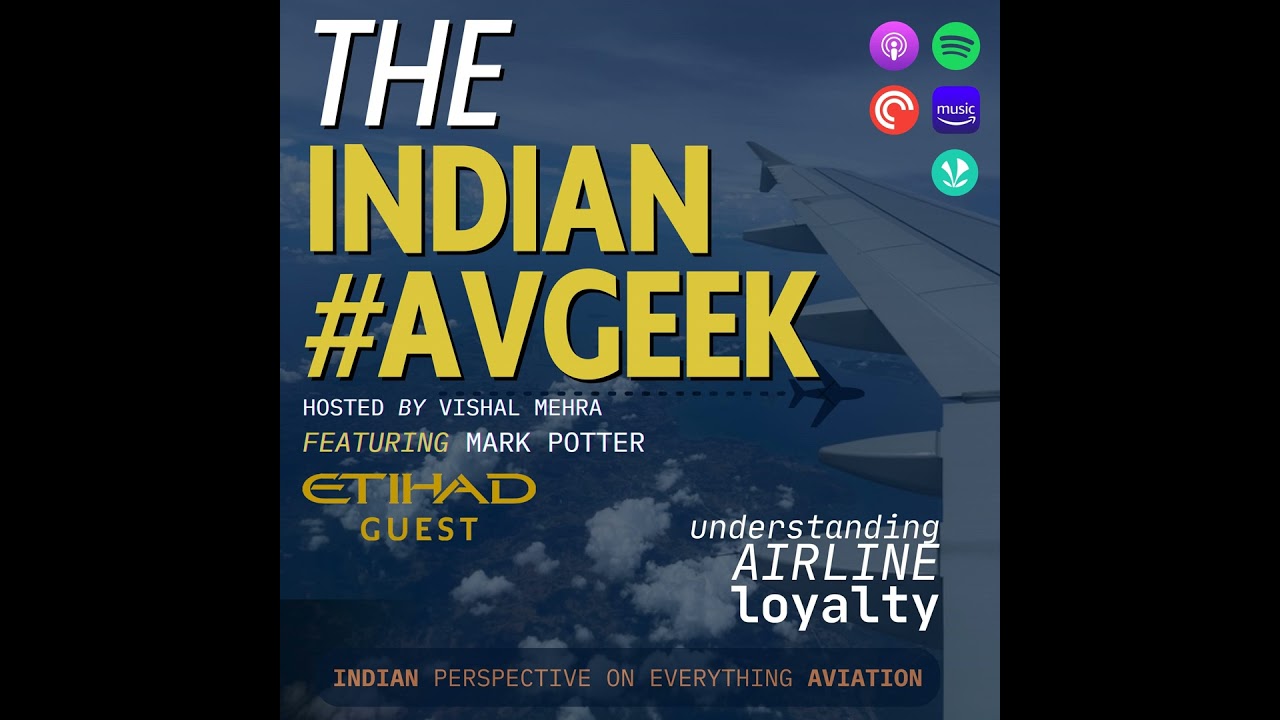
Original interview: The Indian AvGeek — Episode 67. Published 19 April 2026.
Editorial context: This is an interpretation of the interview and available source material, not a verbatim transcript. Guest statements, commercial judgements and forecasts must be read in their 2026 historical context, not as independently confirmed October 2026 conditions.
Editorial Q&A: These five questions and answers are editorial paraphrases, not direct quotations.
Programme note: Loyalty benefits, redemption availability, partner rules and elite status can change; statements here describe the original interview context, not an offer of current benefits.