01 / THE DEEP READ
Editorial analysis
An editorial interpretation of the conversation, distinguishing the guest’s arguments from verified business outcomes.
Marketing as positive memory
Shubhranshu Singh defines marketing as the creation of memorable positive meaning: a bias that gives people a reason to prefer a brand. He expects the work to become faster, more fragmented and closer to transactions while its purpose endures. His concern about shrinking attention is therefore also a defence of storytelling, emotional engagement and patient memory building. Discussing AI agents, he sees potential for better decisions when people use machines, but warns that machines influencing people could change both consumption and the organisation of marketing.
Imitation, culture and managerial resets
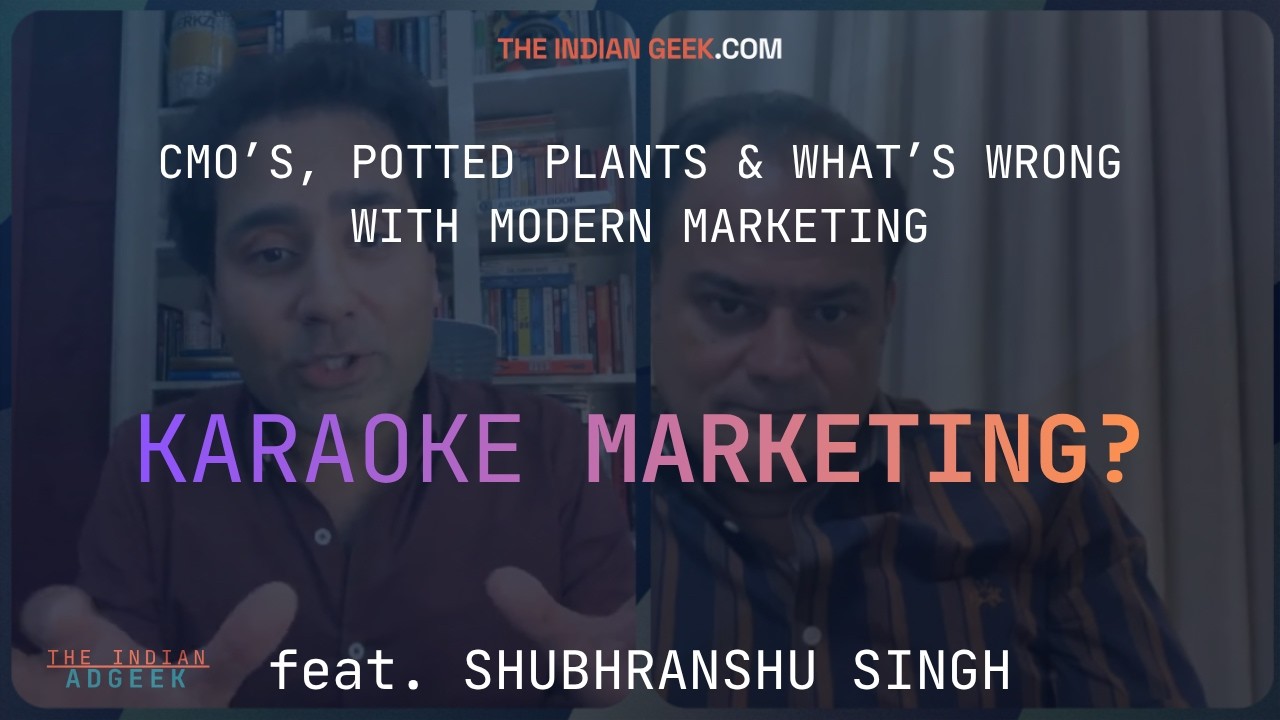
His criticism of karaoke marketing targets the copying of successful formulas across unrelated categories. He urges marketers to collaborate with cultural creators and take original bets. His separate critique of comparative positioning draws on his interpretation of Western psychology and Asian sociology: in India, he argues, brands find meaning through connection as well as contrast. These are Singh’s cultural arguments, rather than universal rules. His potted plant metaphor later describes managers replacing initiatives before they develop roots, while large commitments can encourage confirmation bias. He also warns against crediting advertising alone when distribution, sales support and media investment rise together.
Regaining business influence
For marketing leaders, Singh’s route back to influence combines human emotional understanding with a stronger command of revenue, pricing, penetration and business value. On agencies, he favours understanding the client’s circumstances over polished pitch theatre, and local creative relationships alongside global media and technology systems. He proposes linked scorecards for outcome-based remuneration, acknowledging that agencies cannot control inventory, promotions or product innovation and that clients can make unreasonable demands. The links from awareness to profitability are his proposed framework, not a guaranteed causal sequence or a demand that every result arrive simultaneously. He sees platform concentration as a further pressure on agency economics and asks whether connected-TV creativity uses the medium’s possibilities.
The varying economics of different categories
Drawing on sports and automotive experience, Singh distinguishes frequent purchases from brands that remain meaningful between infrequent buying occasions, while rejecting a blanket dismissal of FMCG-trained marketers. Recalling Mauka Mauka, he credits Star Sports’ in-house team. Creative work can emerge quickly or require cultural immersion; more time alone does not guarantee quality. He values honest questions, the people who will actually service an account and agencies willing to challenge a brief. Looking ahead, he anticipates specialist boutiques and large processing organisations, with the outcome dependent on AI, the economy and holding-company viability. Human creativity, he argues, will continue to have a role.
Marketing’s enduring task is to create memorable positive meaning.
What modern marketing still has to do
An editorial visualisation of the relationships and choices discussed in this episode.
02 / EXPLORE THE ARGUMENT
Questions & answers
What endures when marketing becomes more fragmented?
Singh sees marketing’s enduring purpose as creating memorable positive meaning, even as attention and transactions move faster.
What is wrong with “karaoke marketing”?
Karaoke marketing copies a successful formula across categories; Singh instead urges original bets and collaboration with cultural creators.
What does the potted-plant metaphor criticise?
His potted plant metaphor challenges repeated managerial resets; he also warns that large campaign commitments can hide weak attribution behind confirmation bias.
How can a CMO regain influence in the business?
Marketing leaders should connect their work to revenue, pricing and penetration. Singh sees emotional understanding as a continuing opportunity, while qualifying his assessment of AI’s limits as current.
Should global agencies centralise creative work as well as technology?
Singh favours global systems for media and technology, with local relationships for culturally conditioned creative work.
03 / TRANSPARENCY
Sources & attribution
Supporting references and reporting notes. Select a reference to visit its source.
Original publisher audio (archived enclosure): Original publisher audio (archived enclosure).
Podcast episode on Spotify: Podcast episode on Spotify.
Podcast video on YouTube: Podcast video on YouTube.
Original publication: The Indian AdGeek, Episode 35, featuring Shubhranshu Singh; original publisher date: 2026-09-28.
Method and attribution: This analysis and the five Q&As are editorial syntheses, not verbatim statements or substitutes for listening to the original conversation. Guest judgments, examples, forecasts and reported business metrics should not be confused with independently audited findings. Research timestamps do not represent podcast chapter timings.